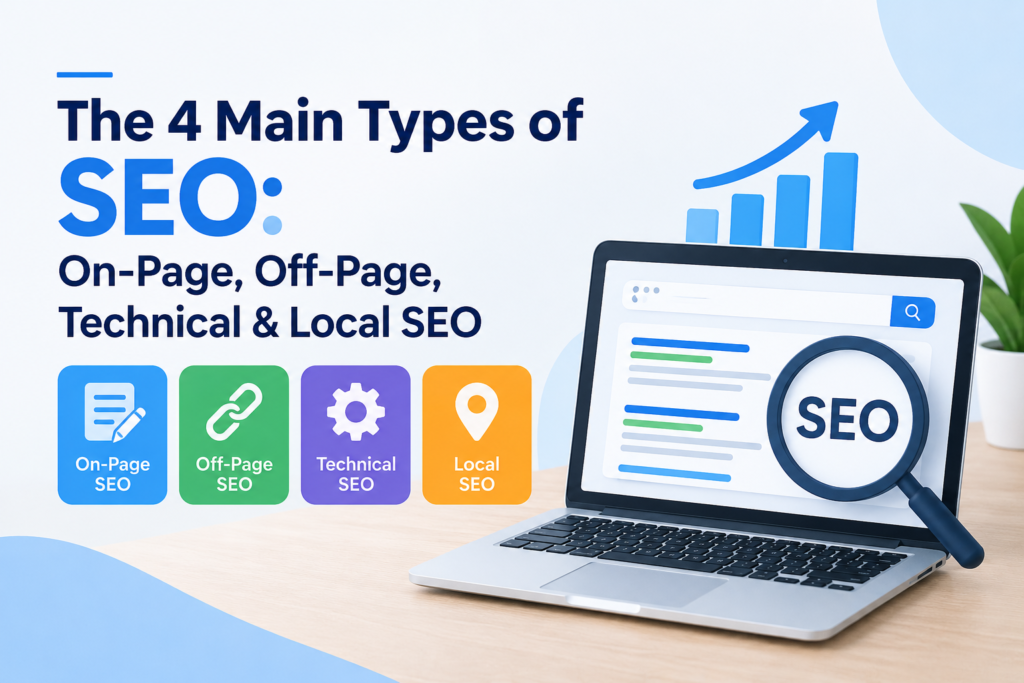
Search engine optimization is not one single task. Improving a website’s visibility in search results requires attention to the content users see, the technical structure behind the website, the reputation it builds across the web, and its visibility in local searches. These areas are commonly grouped into four main types of SEO: On-Page SEO, Off-Page SEO, Technical SEO, and Local SEO.
Understanding the difference between these four types makes it easier to identify what your website needs and build a more complete SEO strategy.
What Are the 4 Main Types of SEO?
SEO covers several activities, but they can be organized into four practical areas. On-Page SEO focuses on improving the content and elements within your website. Off-Page SEO focuses on building credibility and authority through activities outside your website. Technical SEO addresses the technical foundation that allows search engines to crawl, understand, and index your pages. Local SEO focuses on helping businesses become more visible to customers searching for products or services in a specific area.
These four areas have different roles, but they support the same overall goal: helping your website become more relevant, accessible, credible, and visible in search results. Understanding each area can help you decide where to focus your SEO efforts instead of treating SEO as simply adding keywords to a page.
What Is On-Page SEO?
On-Page SEO includes the elements you can optimize directly on your website. Its purpose is to make your pages more relevant to search queries while providing a useful experience for visitors.
Content is at the center of On-Page SEO. Before writing a page, you should understand what your audience is searching for and what information they expect to find. This means considering search intent rather than creating content around keywords alone. The page should answer the user’s question or help them complete the task behind the search.
For example, if you create a page targeting “best home workouts for beginners,” the content should actually help beginners understand suitable exercises, how to get started, and what they may need. The target phrase can be used naturally in the page title, headings, introduction, and relevant sections without unnecessary repetition.
On-Page SEO also includes title tags, meta descriptions, headings, URLs, internal links, images, and image alt text. These elements help search engines understand the subject of a page while making the content easier for visitors to navigate and understand.
Internal linking is another useful part of On-Page SEO. Linking related pages together helps visitors discover additional information and gives search engines more context about the relationship between different pages on your website.
What Is Off-Page SEO?
Off-Page SEO focuses on activities outside your own website that can help build credibility, authority, and visibility. While On-Page SEO improves what happens on your pages, Off-Page SEO helps establish how your website is viewed across the wider web.
Backlinks are a major part of Off-Page SEO. A backlink is a link from another website to your website. Links from relevant and trustworthy websites can strengthen your site’s credibility and help search engines understand that other sources find your content useful.
However, link building is not simply a numbers game. A large number of unrelated or low-quality links is not the same as earning links from reputable websites that are relevant to your industry. A quality-focused approach looks for genuine opportunities to have useful content referenced by appropriate sources.
Off-Page SEO can also include digital PR, industry partnerships, guest contributions, brand mentions, and collaborations. Social media can help increase content visibility and create opportunities for people to discover your brand, although social engagement should not be viewed as a direct substitute for quality backlinks.
What Is Technical SEO?
Technical SEO focuses on the parts of your website that operate behind the scenes. These elements help search engines crawl your website, access your pages, understand your site structure, and determine which pages should be indexed.
Website speed is one area of technical optimization. Pages should load efficiently so visitors can access information without unnecessary delays. Mobile responsiveness is also important because users should be able to navigate and interact with your website comfortably across different screen sizes.
Technical SEO also covers HTTPS, XML sitemaps, robots.txt, redirects, canonical URLs, site architecture, structured data, crawlability, and indexability. These areas can become especially important as a website grows and develops more pages.
A clear website structure is another important consideration. Important pages should be easy to find through logical navigation and internal links. Technical SEO therefore provides the foundation that supports the other parts of your SEO strategy.
What Is Local SEO?
Local SEO focuses on improving visibility when people search for businesses, products, or services within a particular geographic area. It is especially important for businesses with physical locations or defined service areas.
Searches such as “best pizza near me,” “plumber in Chicago,” or “electrician near me” show clear local intent. In these situations, searchers are not simply looking for information; they are looking for a relevant business in a particular location.
One of the central parts of Local SEO is a well-optimized Google Business Profile. Business information should be accurate and consistent, including the business name, address, phone number, hours, category, and services. Relevant photos and genuine customer reviews can also help potential customers evaluate the business.
For a local business, the purpose of Local SEO is to make it easier for nearby customers to discover the business when they are actively searching for what it offers.
How Do the 4 Types of SEO Work Together?
The four types of SEO address different parts of the same goal: improving a website’s visibility and usefulness in search.
On-Page SEO makes the content relevant and helpful. Technical SEO makes the website accessible and understandable to search engines. Off-Page SEO helps build credibility beyond the website. Local SEO improves visibility for searches connected to a specific location.
These areas can support one another. For example, a local business may have well-optimized service pages, a technically healthy website, relevant backlinks from other websites, and an optimized Google Business Profile. Together, these efforts create a stronger overall SEO strategy than relying on one area alone.
Which Type of SEO Should You Focus on First?
The right starting point depends on your website and business goals. If your website has crawling, indexing, mobile, or structural problems, Technical SEO should receive attention first. If the technical foundation is healthy but important pages lack useful or well-organized content, On-Page SEO may be the priority.
A website with strong content and technical performance may need more Off-Page work to build authority and visibility. Businesses that depend on customers in specific areas should also prioritize Local SEO.
Rather than giving every area equal attention, identify the biggest weaknesses and opportunities first. This makes your SEO work more focused and practical.
Final Thoughts
On-Page, Off-Page, Technical, and Local SEO each focus on a different part of your website’s search presence. On-Page SEO improves the content and elements on your pages. Off-Page SEO helps build credibility outside your website. Technical SEO provides the foundation that allows search engines to access and understand your site. Local SEO helps location-based businesses connect with nearby searchers.
You do not always need to work on all four areas at the same level. Start by understanding your website’s current condition, identify the areas that need the most improvement, and build your strategy from there. When these four areas work together, they can create a stronger and more complete foundation for long-term search visibility.