
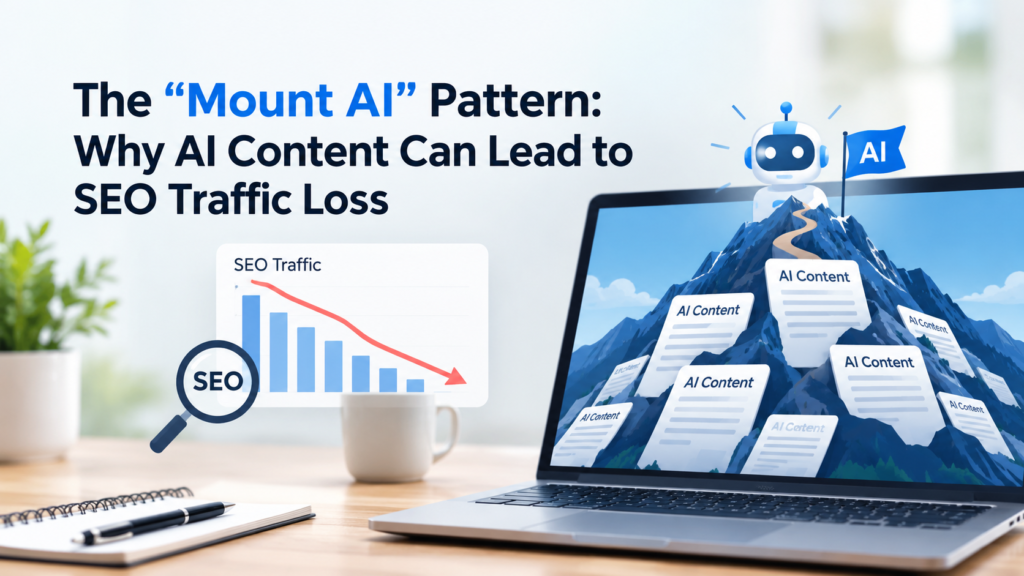
What if publishing more content looks like a winning SEO strategy at first, but the success doesn’t last? AI has changed how we research, write, and publish faster than ever, enabling businesses to cover more topics and even achieve more organic results in the short term. However, quickness is not a good sign of a good content strategy. Problems arise when the primary focus shifts from providing value to publishing volume, originality, expertise, and usefulness for the readers. This is where the concept of the “Mount AI” pattern begins.
The pattern is easy to understand: the more content created, the more organic visibility will rise, and then traffic will peak, and performance might fall off. It is not an absolute rule or a problem with AI itself. The danger lies in using it to produce lots of the same pages, or a thin page, or an uninterested page to readers, or an outdated information page. However, there are numerous other factors to drop traffic, such as competition, algorithm updates, content that’s no longer relevant, or shifting search habits, and so correlation does not establish. This is the first step towards understanding the Mount AI pattern.
What is the “Mount AI” pattern?
An unofficial term for this typical Search Engine Optimization(SEO) traffic curve is the “Mount AI” pattern. A site publishes a lot of content written by AI, then slowly starts to see more traffic over time, then the traffic levels peak, and then they start to fall. The name comes from its appearance on a graph, as a mountain. This may happen when more pages are published at the beginning to help the site rank for more keywords, generate more impressions, and show up in more searches.
The problem begins when there is too much content in place but not enough content value. Repetitive, generic, thin, similar to other pages, or not well aligned to search intent pages likely won’t rank well over time if they’re published on a site that continues to produce this kind of material. The guidance makes it clear that the issue isn’t really with AI itself. It’s about the content being produced to rank well in search engines, not to actually help readers.
The main point to keep in mind about “Mount AI” is that AI can help writers create content faster. It can increase output. It doesn’t change the basic rules of SEO. Content still has to be original. It still needs to be useful. It must be accurate. It must be easy for real people to read and understand. AI can’t replace it.
When does AI content scaling start to create SEO risk?
AI content scaling becomes a risk when a website begins to create content at a faster rate rather than maintaining good quality. Imagine that someone is publishing 50 new articles, but doesn’t have enough time to research, fact-check, edit, update, or enhance each of these articles. Some pages may begin to address the same search query, using the same information and keywords, and over time, may even turn into the same page. The actual challenge is not using AI, but giving more priority to the quantity of publications over quality and usefulness. So every page of content must have a purpose, answer the questions of the readers, and provide valuable information to the user rather than just adding more pages.
So the question is: How many articles or pieces of content can we write with the help of AI so that it is not considered a risk of scale? Actually, it doesn’t have specific numbers. Rather, the better question is: Can you ensure the review and improvement of the content that is published? If the content information is inaccurate or irrelevant, the examples are not properly utilized, there are no links or new content, and the content quality is not feasible, it may be scaling too fast. Therefore, can’t we use AI while writing an article? Yes, we can use it. We can use AI for researching, brainstorming, outlining, summarising, and editing. The risk increases when automation replaces judgement rather than supporting. A healthy SEO content strategy should have a purpose, answer the real question, and add something valuable instead of simply increasing the number of indexed pages. However, sustainable AI content scaling is not about publishing; it is about increasing output without losing the quality and usefulness for the readers.
Why can AI-scaled content gain traffic before performance declines?
How does a website generate dozens of AI-generated pieces of content, and then suddenly find it getting more organic traffic? The primary reason is the increased search visibility. Every new article creates a possibility to find it in Google Search. Some of these pages may be ranking for certain questions or less competitive search queries if Google indexes and ranks these pages. For example, if a digital marketing website offers tutorials on Google Ads, local search, and e-commerce marketing, then visitors may be interested in clicking to other solutions. When more pages can be found in the search results, impressions and clicks will be generated more. But it will work for early growth and not perform well in the long term. Google clearly says that if a website produces more content without maintaining quality and necessity just for appearing, it doesn’t boost its ranking.
But why all the drop in traffic after the initial growth? Attracting visitors is one thing, but providing useful answers is another. If AI-generated content contains the same information, inaccurate facts, or outdated information, after time passes, the original and better content of other sites will rise in the rankings. Google can also alter its ranking because of changes in the systems or content available at Google. A traffic drop isn’t a sign of Google’s punishment of AI usage. This is where the “Mount AI” pattern is: You can create more articles or content using AI and then get more visibility-but for getting long-term results in terms of SEO, it is important that these articles or content stay relevant, accurate, and actually help readers.
What happens when much similar content builds up?
While AI-generated content is published more often without considering quality and necessity, it may lack useful information. If a website generates lots of AI-generated articles, some of the articles might contain the same information. For instance, an SEO website could have three different articles on the topics of “How to Improve On-Page SEO,” “On-Page SEO Tips,” and “Ways to Optimise On-Page SEO”. Though the titles vary, the articles might have the same advice without providing anything new. What’s the value to the reader if he opens three articles and gets virtually the same answer? Very little. The repeated exposure can cause a website navigation to become difficult and reduce the value of its content. It also has the downside of creating additional work for editors, as they will have to maintain multiple similar pages that are accurate and updated.
Similar content can also influence how visible a website is in the search results. Actually, Google does not automatically punish websites for repeating the information and content. If pages have similar information, Google might pick one as the main one to show in search results. The other pages might not show much. Articles that basically focus on the same question and can also compete against each other without giving new information to the readers. If this type of content increases, it won’t help the strong SEO strategy. A better way is to look at articles, bring the similar parts together, and separate pages when they provide different answers to the question. So the goal of making content should be to help readers find answers rather than visiting more pages.
Use AI as a content assistant, not as your expertise
AI helps to reduce the burden of content creation, but it should not be used as a human replacement. Rather, we can use it for brainstorming, getting topic and outline ideas, and making content easier for the readers. But can AI tell why a marketing campaign failed when you haven’t studied the results of that campaign? Take a look at an article on getting Google Ads clicks and no sales. AI may recommend looking at conversion tracking, search terms, and landing page relevance. The following are helpful hints, but do not determine the cause. The experienced marketer should take a look at the actual campaign figures, determine the problem, and explain it. This is where real experience makes general advice come alive and can be trusted by information readers.
The best way to do this is to use a combination of human research and judgment and AI’s speed. Google acknowledges the importance of using AI during research. It can help with content creation research, but we should not use it without checking the information cause it may give inaccurate information. So human justification is necessary; although more content means more search opportunities, it’s the originality, accuracy, and ‘helpful answers’ that create lasting SEO.
Sustainable SEO comes from better information, not more pages
Sustainable SEO is not about the quantity of pages; it is about the quality of the information. Though more pages mean the possibility of showing more pages in the search engine, it doesn’t mean a website will get steady organic traffic. Google indicated that if a website just adds content only to look fresh, it doesn’t bring any long-term benefit for a strong SEO strategy. Rather, if content provides information, personal experiences, expert perspectives, and facts,it boosts SEO performance.
So sustainable SEO requires accurate information, original insights, and practical solutions that answer the search queries. A business might publish a series of articles discussing a drop in website traffic, for instance, but also provide one in-depth article that covers how to find out what is happening to traffic with Google Search Console. The “Mount AI” pattern is a reminder of the importance of quality focus: more pages mean more chances for search visibility in the short term, but it is information that is useful, relevant, and worth reading that will keep that search visibility going in the long term.
Conclusion
The “Mount AI” approach shows a lesson for SEO: putting out more content doesn’t always bring long-term growth. AI-generated content might bring visitors at first because they cover search terms, but that growth can disappear if the pages become the same over and over, old or not helpful. The issue isn’t AI itself. The issue is how it is used. Google wants content that’s helpful, new, and trustworthy no matter how it is made. Finally, good SEO is not about writing content and publishing; it is effective when it keeps the real value.