Have you ever wondered why some Google results give you the exact answer, while others do not? Search intent is the reason or purpose behind a user’s search. Understanding this reason is important, but it is not enough. Search intent works hand in hand with user experience (UX) to decide whether a visitor stays on your site or leaves. When the content gives people what they want through a clean, easy-to-use page, search engines take notice.
In this guide, you will learn what search intent is, its four main types (Commercial, Informational, Navigational, and Transactional), and why matching it matters so much. We will also cover how UX shapes the visitor’s journey right after the click and how to blend both into your SEO strategy. Watch the embedded video below for a quick overview of how search intent and UX work together before reading further.
Search Intent In SEO And Its Types
SEO stands for Search Engine Optimization, which is optimizing a website or online content so it ranks in the SERP (Search Engine Results Page), drives organic traffic, and increases visibility. Search Intent refers to what users or visitors are searching in search engines (like Google, Bing, etc.) and the reason behind the search. Search intent plays an important role in optimization. Using only keywords is not always enough to get the desired result in a search engine; you also need to understand what the user is looking for. This is why understanding the search intent is essential for better SEO.
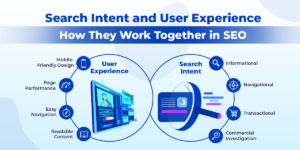
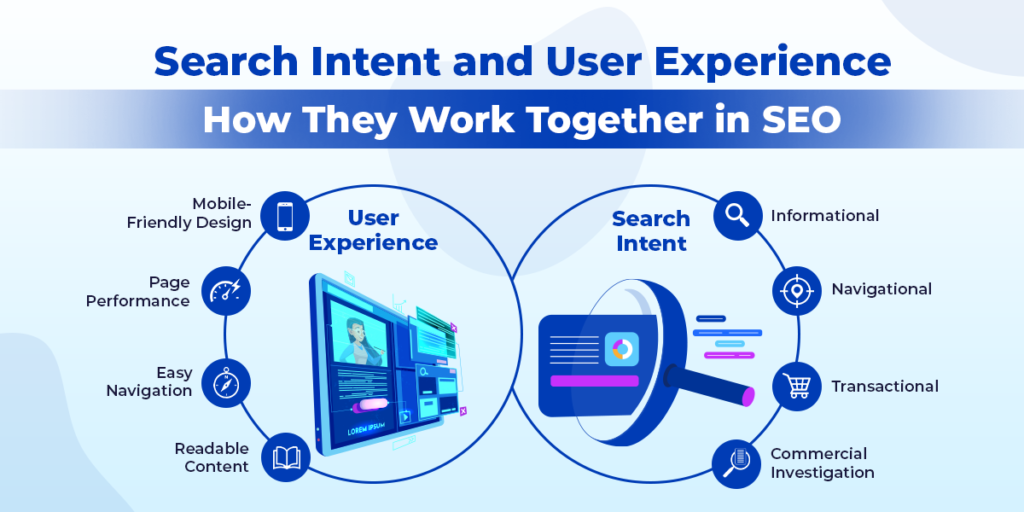
There are four types of primary search intent: Informational, Navigational, Transactional, and Commercial.
Informational search intent happens when users search in search engines to learn or get information, such as “What is SEO and how does it work in search engines?” Navigational search intent is when users search for a specific website or brand in a search engine, like “Netflix login or subscription”. When users buy or take action, it is transactional search intent such as “Buy Nike running shoes online.” Commercial search intent occurs when user comparing or researching products or services, such as “Best running shoes for beginners.”
Importance of Search Intent In SEO And Content Optimization
Search intent plays a crucial role in SEO because search engines seek to meet the needs of searchers by providing high-quality and relevant pages. If a user searches for something and the search engine can easily identify the intention and the user gets correct solutions, it gets ranked in the SERP. It is also important that when a user enters the page and doesn’t get relevance, the user leaves immediately, and search engines count it as a bounce rate, which is negative for the SEO strategy. By understanding search intent, you can produce content that resonates with your target audience. If we focus only on the users’ search instead of focusing on why and what they are searching for, it is difficult to get a higher rank in search engines.
Search engines like Google and its algorithm mainly provide relevant results to users. Since search engines’ main aim is to provide helpful results to users for what they want, search intent plays an important role in SEO. On the other hand, if a search engine can’t understand the intent, it targets the wrong audience or provides irrelevant results to the audience. When a user uses a search engine mostly for finding information, purchase or services. Using and optimizing search intent, it reduces the gap between the user and the content creator. As a result, the content gets more traffic and user engagement.
How To Understand Search Intent By Analyzing Google SERPs?
Google search basically works in three dimensions: crawling, indexing, and ranking. Search intent plays an important role in ranking. At first, google bot crawl the webpages and content. Google will be able to put the page in its index if it finds a relevant page. A user types in a search query, and Google interprets that query and shows the results it believes are most relevant to the query. Search intent is important in the ranking stage because Google shows the results that best match the user’s search and what they actually want.
If you have an understanding of the purpose of the search, then you have an understanding of what the audience is looking for and what they expect out of a search.
It’s not simply keyword matches with content that make for the right audience. Google also tries to guess at the intent of the user’s request and what they plan to do with the information. We need to analyze content type, content format, and content angle to rank content on the SERP. These factors will give us detailed insight into the types of pages that are ranking and how the information is provided. This is the case of blog posts, product pages, guides, comparisons, and more. Taking the time to look at phrases and words that consumers are searching for to make a match is also important. Google then processes the search, looks at what pages are relevant, and displays the relevant pages that best respond to the searcher’s needs.
Key Difference Between Search Intent And Keywords
The relationship between keywords and search intent in SEO is a complementary one, with different functions. Keywords are the words or phrases used by the person who performs the search on a search engine, and search intent is what they are trying to accomplish by searching that particular term. Actually, keywords are used to identify the search term, which has a search volume, whereas search intent is used to understand the user’s goal. When someone searches for something in a search engine, they probably have an outcome in mind. They may want an answer; if they get the particular website, they compare and then take action.
For example, when a user searches “Digital marketing” for knowing definition or to get information, but if the page shows a marketing course, the user leaves the page immediately. Google counts it as a bounce rate and it sends a signal to Google that this page is not relevant or does not have enough content to quench the thirst of the searcher, and the page may lose its ranking potential. It is not sufficient just to use keywords to make a successful SEO campaign. When keywords and search intent work together, content becomes more effective, relevant, and aligned with the audience.
What Is User Experience In SEO?
In SEO, user experience (UX) refers to the ease with which users can navigate a website, comprehend its information content, and locate what they are searching for. Actually, UX is directly related to SEO because search engines like Google give a higher rank in SERP depending on user intent, smoothness, and interaction. A good user experience is when a user easily understands the content, visits the different pages of the website, and takes action without any difficulties. Google’s ranking algorithm works on many factors, but the main and most important factor is user experience. By understanding the user experience, we can rank the website in the SERP easily.
There are many key factors that work for UX (user experience), such as page speed, mobile friendliness, Core Web Vitals, easy navigation, helpful internal links, and clear calls to action. To improve UX in SEO, we have to make content based on search intent, easy to read, with clear navigation, and with good page performance. If a website has a low bounce rate, high user engagement, and better core web vitals easily get the rank in search engines. User experience is not only about the design of the website, it also relies on the ability of its visitors to comprehend, navigate, and interact with the interface and content. Even a good design website gets a poor user experience if a user can’t find the answer they are looking for.
Why Google Cares About User Experience?
Google cares about user experience because Google gives the highest priority to user satisfaction and user activity. Google always wants to deliver the most accurate, fastest, and user-intent results. Actually, Google handles billions of searches regularly. If a user faces slow, unmatched results and an unorganized website, they shift to another competitive search engine. As a result, Google measures many metrics to rank the website in search results.
There are several things Google cares about when measuring user experience. One of the important metrics is page performance, including page loading, responsiveness, and visual stability. It affects whether the user engages with the website. Since many users search from mobile phones, Google checks that the website displays or functions properly on mobile devices. A mobile-friendly design supports both usability and quality of the page. People are more comfortable using a secure website rather than an insecure website. Google recommends secure website delivery with HTTPS and avoiding designs that interfere with the main content. Google itself explains that there is no single metric that is mostly used to rank the page. The primary purpose is to create a useful, usable, and visitor-centric website.
How Search Intent And User Experience Work Together?
Search intent helps to understand exactly what users are looking for when they are searching on a search engine. It identifies the purpose behind the search query and helps to create the content according to the user’s needs. For example, a user is searching for informational content: “What is SEO?”The user will expect a clear explanation of it rather than sales-focused pages. By understanding the search intent, we can understand what information should be provided, what type of content should be made, and what topic should be covered. It will help to attract the right users with relevant content.
User experience determines how easily a user can access, understand, and interact with the content when they enter the page. Even when a page matches the user’s search intent, poor UX causes users to leave the page immediately. Slow-loading pages, confusing navigation, poor mobile-friendliness, and unreadable content may interrupt the user’s experience with the content. A clear structure, better page performance, simple navigation, and readable content can keep users engaged with the website and make it easier to find desired information. Therefore, strong SEO combines both elements for a better user experience.
Conclusion
Search intent and user experience are two essential parts of a strong SEO foundation and digital presence. Both are directly related to each other. One helps the user to find the right content, while the other provides the experience of using it. Only focusing on search intent is not enough if the page is slow, confusing, and difficult to navigate. Before optimizing a page, we should analyze the search intent and the types of content that appear in search results, then present it in a way that users can easily and smoothly consume, making a useful and simple user journey. When search intent and user experience work together, a website can attract the right audience, improve engagement, support conversion, and achieve better long-term organic performance.