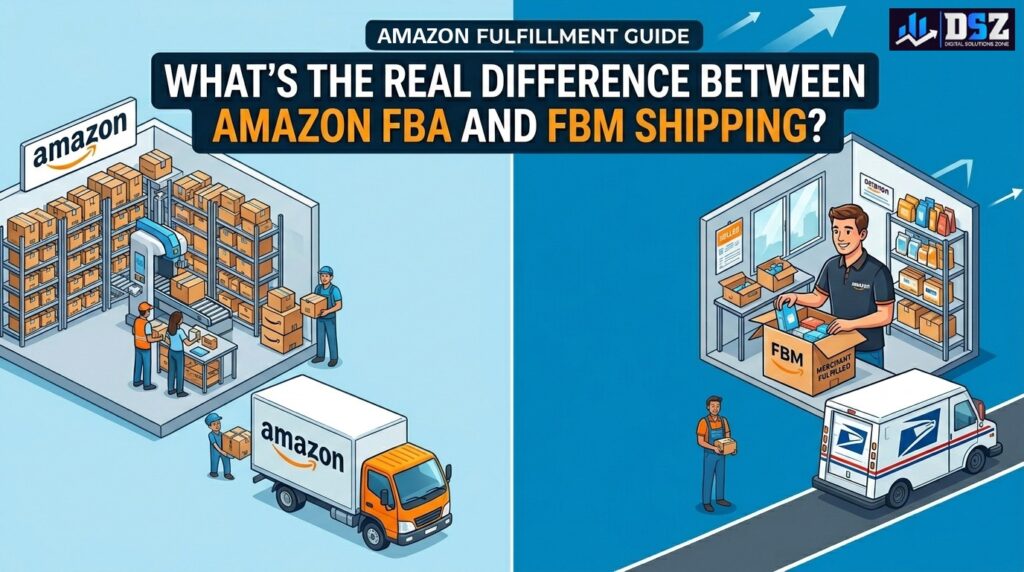
Selling on Amazon is one of the fastest ways to grow an eCommerce business, but one of the most important decisions you’ll make as a seller is choosing the right fulfillment method.
Should you use Amazon FBA (Fulfilled by Amazon) or FBM (Fulfilled by Merchant)?
While both options allow you to sell on Amazon, they impact your profit margins, operations, customer experience, and long-term scalability in very different ways.
In this guide, we’ll break down the advantages and disadvantages of both fulfillment models and help you determine which option is best for your products.
What Is Amazon FBA?
Fulfilled by Amazon (FBA) is a service where Amazon handles storage, packing, shipping, customer service, and returns on your behalf.
Here’s how it works:
- You send inventory to Amazon’s fulfillment centers.
- Amazon stores your products.
- When a customer places an order, Amazon picks, packs, and ships the product.
- Amazon also manages customer inquiries, refunds, and returns.
Benefits of Amazon FBA
Prime Eligibility
One of the biggest advantages of FBA is the Amazon Prime badge. Prime members often prefer products that offer fast and free shipping, which can significantly improve conversion rates.
Hands-Off Fulfillment
Amazon handles the logistics, allowing sellers to focus on sourcing products, marketing, and business growth.
Better Customer Experience
Amazon’s fulfillment network ensures fast delivery and professional customer service, helping improve customer satisfaction.
Higher Buy Box Potential
FBA products generally have a competitive advantage when competing for Amazon’s Buy Box.
Drawbacks of Amazon FBA
While convenient, FBA comes with costs and limitations.
Rising Storage Fees
Amazon charges monthly storage fees and long-term storage fees for inventory that remains unsold for extended periods.
Inventory Performance Requirements
Sellers must maintain a healthy Inventory Performance Index (IPI) score. Poor inventory management can lead to storage restrictions and additional costs.
Less Inventory Flexibility
Amazon’s inventory requirements and storage limits can sometimes make stock planning challenging, especially during seasonal demand fluctuations.
What Is Amazon FBM?
Fulfilled by Merchant (FBM) means you are responsible for storing, packing, shipping, customer service, and returns.
You can fulfill orders from:
- Your own warehouse
- Home storage
- A third-party logistics (3PL) provider
When an order is placed, you or your fulfillment partner handle the entire shipping process.
Benefits of Amazon FBM
Greater Inventory Control
You maintain full control over your stock levels, storage methods, and fulfillment processes.
Lower Costs for Large Products
For oversized, heavy, or bulky items, FBM often results in lower fulfillment costs compared to Amazon’s fees.
Flexibility for Custom Products
Businesses selling made-to-order, personalized, or customized products often find FBM more practical.
Ability to Use Alternative Shipping Solutions
Many sellers negotiate favorable rates with carriers or partner with 3PL providers to reduce fulfillment expenses.
Drawbacks of Amazon FBM
Increased Operational Responsibility
You’ll be responsible for:
- Packing orders
- Shipping products
- Managing returns
- Responding to customer inquiries
No Prime Badge (for Most Sellers)
Unless you qualify for Amazon’s Seller Fulfilled Prime program, FBM listings generally won’t receive the Prime badge.
Higher Customer Service Demands
You’ll need systems and staff in place to maintain a positive customer experience.
FBA vs FBM: Which Products Are Best for Each?
The best fulfillment method often depends on the type of product you’re selling.
Products That Typically Perform Best with FBA
FBA is usually ideal for:
- Small, lightweight products
- Fast-moving inventory
- Highly competitive categories
- Products where Prime shipping significantly influences purchasing decisions
Examples include:
- Garlic presses
- Phone cases
- Supplements
- Kitchen gadgets
- Beauty products
Because these items are inexpensive to store and ship, FBA’s convenience often outweighs its costs.
Products That Typically Perform Best with FBM
FBM tends to work better for:
- Heavy products
- Oversized products
- Slow-moving inventory
- Custom-made or personalized products
- Seasonal products with unpredictable demand
Examples include:
- Furniture
- Couches
- Large lampshades
- Custom engraved items
- Specialized equipment
These products can incur substantial storage and fulfillment fees under FBA, making FBM a more profitable option.
Real-World Example: Garlic Press vs Couch
Let’s compare two products:
Garlic Press
- Small and lightweight
- Fast-moving inventory
- Low storage costs
- Low shipping costs
- Strong Prime demand
Winner: FBA
Amazon’s fulfillment network can ship these products efficiently and profitably.
Couch
- Large and bulky
- Expensive storage requirements
- High shipping costs
- Potentially slower sales velocity
Winner: FBM
Storing and shipping large furniture independently or through a specialized 3PL provider is often more cost-effective.
How to Determine Which Option Is More Profitable
Instead of guessing, use data.
The best way to evaluate FBA versus FBM is by using Amazon’s FBA Revenue Calculator.
Step 1: Find a Similar Product
Locate a competitor’s ASIN that closely matches your product.
Step 2: Enter the Product Information
Input dimensions, weight, selling price, and fulfillment details.
Step 3: Compare the Costs
Review:
- Referral fees
- Fulfillment fees
- Storage fees
- Estimated profit margins
Step 4: Compare Against Your Own Costs
Calculate:
- Warehouse expenses
- Packaging costs
- Shipping costs
- 3PL fees (if applicable)
Step 5: Make a Data-Driven Decision
If Amazon’s fulfillment costs are lower and Prime benefits improve sales velocity, FBA may be the best choice.
If your own fulfillment operation or 3PL provider offers lower overall costs, FBM could generate higher profits.
The Hybrid Strategy: Best of Both Worlds
Many successful Amazon sellers don’t choose just one method.
Instead, they use a hybrid approach:
Use FBA For:
- Best-selling products
- Fast-moving inventory
- Products that rely heavily on Prime eligibility
Use FBM For:
- Oversized items
- Seasonal products
- Backup inventory
- Custom or made-to-order products
This strategy allows sellers to maximize sales while maintaining operational flexibility.
Final Thoughts
There is no universal answer to the FBA vs FBM debate.
The right choice depends on:
- Product size and weight
- Sales velocity
- Storage requirements
- Shipping costs
- Customer expectations
- Profit margins
As a general rule:
Choose FBA If:
- You sell small, lightweight, fast-moving products
- Prime shipping is essential for competing in your category
- You want Amazon to handle customer service and fulfillment
Choose FBM If:
- You sell oversized or bulky items
- You offer customized or made-to-order products
- You have access to efficient fulfillment operations or a reliable 3PL partner
Most importantly, run the numbers before making a decision. The most profitable fulfillment strategy is the one backed by data—not assumptions.
Need Help Growing Your Amazon Business?
At Digital Solutions Zone (DSZ), we help brands scale across leading marketplaces including Amazon, Walmart, eBay, Etsy, Wayfair, Best Buy, B&Q, and Target.
Our services include:
- Amazon Account Management
- Product Listing Optimization
- Keyword Research
- A+ Content Creation
- Store Design & Development
- PPC Advertising Management
- Product Branding
- Conversion Rate Optimization
- Marketplace Expansion
Whether you’re launching your first product or scaling an established brand, our team can help you build a profitable eCommerce business.
Ready to grow your sales? Contact Digital Solutions Zone today and take your marketplace business to the next level.